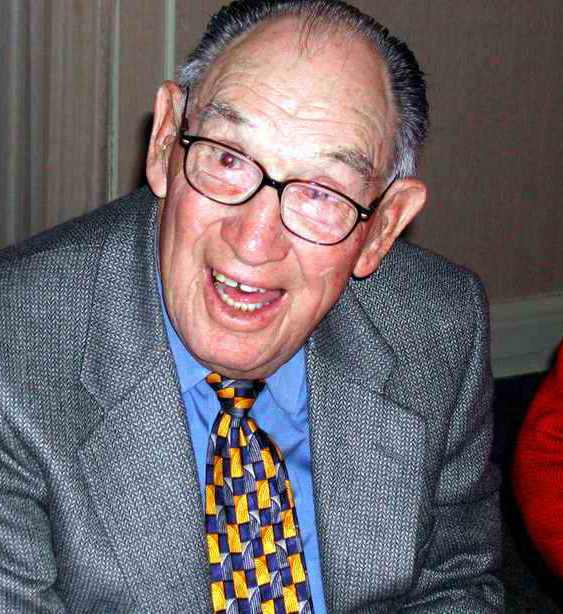
Ace Parker was the son of Ernest and Mabel Parker and grew up near Norfolk, Virginia. He attended Woodrow Wilson High School in
Portsmouth, graduating with the class of 1933 and starring in five sports. He enrolled at Duke as a freshman in 1933.
At Duke, Ace competed in three sports: football, basketball, and baseball. From 1934 - 1936, he starred at tailback, doing most of the running
and passing for Duke. He was second team All-American in 1935 and consensus All-American first team in 1936. He placed sixth in the
Heisman Trophy voting in 1936. Parker was a great open-field runner and probably the best punter in college football at the time. His 105 yard
kickoff return against North Carolina is still a Duke school record. Parker also stood out as a baseball player at Duke, playing in 1935-1936.
He was elected into the College Football Hall of Fame in 1955. He was inducted into the North Carolina Sports Hall of Fame in 1963 and was an
inaugural member of the Duke University Sports Hall of Fame, inducted in 1975.
Parker was drafted by the Brooklyn Dodgers as the third pick of the second round in the 1937 NFL draft. Sammy Baugh
was the only passer drafted ahead of Parker. Parker, who played for the Philadelphia Athletics of Major League Baseball beginning in 1937,
originally had no intention of playing in the NFL. Baseball was the glamour pro sport at the time and the NFL had a rough, vulgar reputation.
But, perhaps because of his 0.117 batting average that year, he asked for and received permission from the A's to play football. Parker thus
became a true two-sport phenomenon, playing both Major League Baseball and NFL football in both 1937 and 1938. Parker, playing
various infield positions, batted 0.179 over two seasons with the A's , scoring 20 runs with 25 RBI over 94 games.
When Ace Parker joined the Dodgers in 1937, Brooklyn had been a perennial NFL cellar-dweller in the East Conference since 1930.
With his running, passing, and punting ability, he brought them instant credibility. He led the team in passing in 1937 and every year he played.
In 1938, he led Brooklyn to a 0.500 record and led the NFL in passing yards with 865. When legendary coach Jock Sutherland joined the
Dodgers in 1940, Parker's career took off. In 1940, he threw for 817 yards and 10 TDs, rushed for 306 yards, caught 3 passes, including
2 for TDs, and led the league in points after touchdowns. The Dodgers finished only one game out of first, with an 8-3 record, and Parker
was named the NFL MVP. In 1941, Parker continued to shine, but the Dodgers again finished second to the New York Giants, despite
beating their New York rivals twice during the season. Parker's NFL career went on hold in 1942, as he, like many NFL players, left football to
enlist in the Armed Services. After serving for over two years, Parker returned to the NFL, this time with the short-lived
Boston Yanks, but at age 33, he took on a minor role.
He rejoined the former owner of the Dodgers, Dan Topping, in 1946 as part of the New York Yankees of the new
All-America Football Conference (AAFC). Coached by former
Washington Redskins coach Ray Flaherty and led by Parker, the Yankees won the AAFC East, giving Parker his
only division title in pro football. The Yankees met the powerful Cleveland Browns in the championship game. The Yankees played
well, but eventually succumbed to the Browns. Parker was 8 of 18 passing, for only 81 yards and an interception. Parker retired
after the game, completing a fine career at age 34. He was inducted into the Pro Football Hall of Fame in 1972.
Clarence McKay “Ace” Parker, a member of the Pro Football Hall of Fame and arguably the greatest, most versatile athlete in the history of Hampton Roads, died earlier today. He was 101 and had been hospitalized since late October with pulminary problems.
Parker, of Portsmouth, was enshrined in the Pro Football Hall in 1972, 25 years after ending a career in which he won the NFL’s most valuable player award in 1940. Parker also was selected to the College Football Hall of Fame and the Virginia and North Carolina sports halls of fame.
Although his fame came during a seven-year career in the NFL and All-American Football Conference, baseball always played a prominent role in his life.
Parker played shortstop for manager Connie Mack’s famous Philadelphia Athletics in 1937 and 1938. Although he hit a home run in his first major-league at-bat, Parker was not the star in big-league baseball that he was on the gridiron. His career batting average was under .200.
“I always thought I was a better baseball player than I was a football player,” Parker said in a 1985 Virginian-Pilot story. “But football seemed to work out better for me.”
Even so, he continued to play and manage baseball at the minor-league level. He was leading the International League in batting in 1940 at Syracuse when he broke his left leg. When the season was over, he went back to the football Dodgers and edged out Washington’s Sammy Baugh for league MVP despite playing the first three games of the season with a 15-pound brace on his leg.
Two years earlier, Parker also beat out Baugh to lead the league in pass completions and passing yards.
What made his athletic accomplishments even more astonishing is that his career was interrupted by a three-year hitch in the Navy as a lieutenant in World War II.
Just 5-feet-10 and 178 pounds, Parker played quarterback, but that was hardly the extent of his contribution. He also was a runner, receiver, punter, kicker, and safety on defense. In addition, he returned punts and kickoffs.
In a 60-minute football game, he frequently averaged more than 50 minutes of playing time. He once proudly recalled that he played 57 minutes in a loss to the Redskins and received a standing ovation from Washington fans as he exited the field.
In 1946, he led the New York Yankees to the All-American Football Conference playoffs, but the Yankees were defeated by quarterback Otto Graham and the Cleveland Browns.
During his MVP season, Parker passed for just 817 yards in 10 games and rushed for 306 yards.
On Oct. 22, 1939, Parker starred in the first pro football game ever televised, a 23-14 victory over the Philadelphia Eagles at Ebbets Field. In his account of the game, New York sportswriter William H. Taylor raved about a pass Parker threw to end Perry Schwartz that “traveled close to 50 yards in the air” – commonplace in today’s NFL but a rare and mighty heave in those days. Schwartz caught the ball to complete a 47-yard touchdown play.
Parker not only had talent, he knew talent. A star quarterback at Duke from 1934-36, he returned to his alma mater as head baseball coach and offensive backfield coach for the football team from 1951-66.
One of Parker’s players was quarterback Sonny Jurgensen, who as a senior in 1957 wasn’t considered an NFL prospect because he’d thrown fewer than 60 passes during his final season.
But Parker phoned a friend on the coaching staff of the Philadelphia Eagles and invited him to visit Duke and watch Jurgensen work out. Parker was convinced Jurgensen had the ability to become an effective pro passer. The assistant traveled to Durham, and left with a changed opinion of Jurgensen.
That year, the Eagles drafted Jurgensen in the fourth round. During 18 pro seasons, he developed into one of football’s most prolific pure passers with the Eagles and Washington Redskins and was inducted in the Hall of Fame in 1983.
“I have to credit a lot to Ace Parker,” Jurgensen said in a 2000 interview. “He’s the one who called the offensive coordinator at Philadelphia and told him that I could throw the ball.”
Parker grew up in Norfolk County and initially attended Churchland High School. But he dropped out of school when Churchland dropped its football program and went to work for Belt Line Railroad.
While on the old City Park Golf Course in Portsmouth, he was approached by two Wilson High coaches who convinced him to attend their school by promising to waive a fee Parker would have had to pay because he lived outside Wilson’s attendance area.
It may have been the best offer he ever received. At the least, it had a dramatic impact on his life.
At Wilson, Parker was a triple-threat quarterback and a forward on the basketball team. A shortstop and pitcher, he led the baseball team to the Tidewater championship in 1933. In track, he won the state high-jump title.
In 1932, he beat pro golfing great Sam Snead in a long-driving contest at the Virginia high school tournament in Roanoke, averaging 303½ yards on three shots. He was the No. 2 player on a state champion golf squad that featured future PGA
Champion and lifelong friend Chandler Harper.
In a 1989 interview, Harper said of Parker: “In my lifetime, I’ve met a lot of giants in their endeavor – Henry Ford, Bing Crosby, Ty Cobb, Eddie Arcaro, Rocky Marciano, Ben Hogan, Jack Nicklaus, Arnold Palmer, Joe DiMaggio – but the first giant I met was Ace Parker.”
Compiled by former Virginian-Pilot sportswriter Jim Ducibella, with an assist
from former staffer Bill Leffler.
|